A car uncouples from a train, and curiously overalled children divert it to an isolated, mountainous country named Gudavia, a land where no trains ever come. The only two passengers on the train car, a boorish American and a stuffy Brit, are apprehended and thrown into a dungeon-like prison for being spies. Meanwhile, scientists in satin jumpsuits armed with an enormous laser gun scientifically impregnate human subjects dressed in odd military garb with electricity, turning them into idiots.
The two men are abruptly released, but they cannot leave the country because Gudavia's sole automobile is being used for official Gudavian business out of the country, which sounds fine. The Brit attempts to send a telegram, but it can't be sent because telegrams are only sent on special occasions. A young girl plays the piano as an oddly Aryan young man scowls.
Suddenly, there is a hubbub in the streets, and an old dude says, "In the end, the murdering will cease", because of course he does, and a guy with an extravagant hat chalks it all up to hysteria. In spite of the hubbub, the hysteria, and the murdering, the Brit wonders aloud about identity of his milliner. Somnambulant figures sneak up on the Brit, and they scatter after someone blows a whistle.
The pair meets up with a scientist with a double identity. This mysterious scientist pulled a disappearing act some time ago due to some sort of political thing (hint-hint, nudge-nudge), and he says some stuff about gamma rays. They then meet a Frau, who has children making monster masks for an upcoming festival, and there's almost nothing sinister about that at all.
Some stuff happens. The Brit chases a boy and falls in some water, the zombie guys throw rocks, a mule makes an appearance, and several people fall off a cliff.
The carnival that is certainly not a special occasion and that was forbidden to happen happens, and it's pretty freaked out, which means it's pretty cool, and the festival-goers wear giant monster heads, which I'm always a big fan of. Don't worry, since it's not too bad it only lasts a couple of minutes.
The Gamma People is a comic thriller, and it isn't particularly comic or thrilling.
Scattered around my home are many small journals. They're on shelves, stacked on end tables, and they fill various drawers and cabinets. Within them are my notes on the bad films I watch late at night, scribbled in the dark. They're mostly illegible, written in a shorthand I often struggle later to decipher. I try my best to finish the reviews, but sometimes one will slip by me. This is one of those reviews.
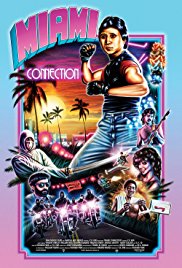
In a city where everyone seems to know martial arts, dudes sit around and wait for a nighttime delivery. Ninjas approach. Surprise! They're delivering drugs, and it's not very surprising. Suddenly, a henchman gets a throwing star stuck in his neck as a repetitive synth soundtrack plays. Disposable extras appear on motorcycles, resulting in a terrible gun battle and sword fight. A band named Dragon Sound consisting almost entirely of John Oates lookalikes performs shirtless with Linn drum.
A classroom of students at a community college begins programming CPUs as big as a microwave oven, and meanwhile, an unconvincing rumble in the school's parking lot is averted through terrible dialogue. A shouting match at a nightclub ends abruptly. Back at the ninja hideout, ninjas practice ninja stuff, then everyone has lunch. Dragon Sound performs another song with pyrotechnics about ninjas in a style reminiscent of Pat Benatar, which should annoy Pat Benatar.
Carloads of men yell at one another and wave sticks around. Shirtless guys in a room decorated by an inexplicable Leif Garrett poster argue over a letter. Then everyone goes to the beach, gets pelted by shoes, and unappetizingly make out. Back at the community college, people spar in slo-mo. After someone gets their nose pinched by toes, everyone enjoys a Pepsi.
Some guys try to dine-and-dash, and then revealing short shorts and camera shadows make an appearance. After breakfast and more mail, a boom mic appears. Then ninjas run across a bridge.
In the rock'em-sock'em world of Miami Connection, Florida seems soley populated by 40 or 50 male characters and one woman, and they're all martial artists who practice an amusing form of martial arts that always defeats someone with a weapon. Featuring terrible acting, a terrible script, terrible music, terrible cinematography, terrible lighting, and terrible fight choreography, Miami Connection is pretty terrible, and it appears to be made up almost entirely of montage.
Currently, I'm on hour 3 of listening to La Monte Young's 5-hour long improvised solo piano work The Well-Tuned Piano.
What does that have to do with Attack Of The Mushroom People? Nothing, really.
Just thought I'd throw that out there. Cut to film.
A man is locked away in a psychiatric ward, and he is our narrator, which isn't a good sign. A young woman sings aboard a boat backed by green screen, then the boat hits some rough seas, and then it cuts to smooth sailing. After some turbulent, Gilligan's Island-like ocean footage, people seem to manage playing cards below deck in spite of ship-sinkingly dangerous waves. Piloting the ship is a fellow wearing sunglasses. A female says she's seasick, which prompts someone to decide that's a good enough reason to turn back despite the obvious typhoon.
A giant steamer heads directly toward the tiny ship. Someone weakly waves to try to stop the inevitable collision, but alas, it was just a dream. Finally, lost and adrift without a mast, the castaways discover land. Leaving their boat, they all bellyflop into the beach, as one does when one reaches the shore of a deserted island.
After eating a suspect berry and finding a tiny pool of water, they run slowly along the foggy beach and discover a shipwreck that's just crawling with fungus, which they promptly get all over them. Some half-hearted scientific inquiry follows, where radioactivity is briefly discussed. A giant mushroom in a box is discovered. Sunglass guy goes below and sneakily eats Spam.
After tons of movie, a mushroom person finally appears, shuffling slowly down the hallway toward them. Cut to next morning, and they all claim it was a ghost. Then everyone bickers.
More movie happens, with zero mushroom people or attacks by them. The castaways argue over canned goods.
Mushrooms grow at great speed with dramatic music accompaniment. After a long walk in the rain, someone is talked into eating mushrooms, then showgirls do flips. It's fairly psychedelic, and it's a welcome change of scenery from jungle foliage and button mushrooms. Finally, someone is chased by mushrooms. It's not very interesting.
The mushrooms attack, and it's exactly what you would expect; lots of shuffling and an over-abundance of dusty spores. Someone loses an arm. A few of the mushroom people look like broccoli. The victims take on an appearance of half-human mushroom hybrids. I'm suddenly hungry for stir-fry, or maybe a nice pasta.
A vegetarian chicken substitute would work fine in that recipe, JSYK.
Attack Of The Mushroom People is pretty boring until last last few minutes of the film. Mushroom enthusiasts would be wise to skip right to the bonkers ending.
Something alarming happened to me recently. While perusing Wikipedia, as I often do, I stumbled upon an entry for a philosophy called hauntology, and I couldn't be more upset about it. I was under the assumption that I alone was "haunted by the nostalgia of lost futures", and just for once I'd like to be seen as the visionary that I am, and not some Johnny-Come-Lately to a philosophy coined by Jacques Derrida in 1993. Don't you just hate it when that happens?
Here I am, sitting here minding my own business listening to the cheesy, futuristic lounge of Frank Comstock and His Orchestra's "Music From Outer Space", with a tab open to an online emulator for the Roland TR-808 drum machine that I will never use, and watching a documentary about men who are trying to build time machines, and who even does all that? Apparently, not just me, or else these things wouldn't exist. Or would they?
I suppose there are people out there who are "exploring ideas related to temporal disjunction, retrofuturism, cultural memory, and esoteric cultural references from the past", and those people need to get out of my scene and its rich, ironic aesthetic. This town ain't big enough for the both of us.
Again, here I am, trying to be as original as all get-out, and there are others out there that are into "vintage analog synthesisers, library music, old science-fiction and pulp horror programs (including the soundtracks of the BBC Radiophonic Workshop), musique concrète and found sounds, dub and English psychedelia, and 1970s public informational films.", and why are those people copying everything I do? Get out of my scene, you bunch of poseurs.
Here I sit, heartbroken for the lack of hovering, anti-gravity vehicles because you all insist on cars, and lo and behold, someone has already pined over it.
This was supposed to be the future, and it sucks.
Thanks for nothing.
Anyway, How To Build a Time Machine is an interesting documentary about two men who created their own time machines. One guy is a film professional who worked on Pee Wee's Playhouse, and built a hand tooled marble, brass, and mahogany replica of the original machine from the 1960 film The Time Machine directed by George Pal. The other subject of the documentary is a scientist who is attempting to create an actual, working time machine utilizing a ring of lasers that drags a neutron around a circle of light. Throughout the film, explanations of film techniques including stop motion, time lapse, and montage, and discussions of the theory of relativity and black holes are integrated into footage of the building of each machine.
An astonishing moment occurs in the film when the film-maker visits a guy who owns the original time machine prop from the film, and casually shows the collector has the original metal skeleton of the King Kong puppet, and the costume from the 1940s serial The Adventures of Captain Marvel, which caused me to gasp in amazement.
Don't even get me started on how I feel about the new Shazam film, slated for release in 2019, which is in the future. That's a discussion for another day, which will also be in the future.
Anyway, How to Build A Time Machine is a fascinating look at obsession, regret, and the struggle with imperfection.
*All the quotes are attributed to the original wikipedia article on hauntology, found at this link if you're interested, but seriously, get out of my scene.
Like, honestly, who wouldn't click on a title like that? Vampire. Skeletons.
A documentary about a recent archaeological find of a medieval burial in Ireland where the unfortunate people were mutilated in an effort to keep them from returning as vampires, Vampire Skeletons features footage of archaeological digs and grisly stories of the undead. Oh yeah, and startling images of unearthed graves containing skulls with large stones shoved in the jaws.
Scientists give explanations of how corpses can sometime explode underground due to gasses, and how they make a popping noise above ground. Also, the bodies can also contort wildly in their graves, which give the suggestion the corpses became reanimated. The stones could have been used to keep a soul from reentering the body, becoming undead, and haunting the living.
Through body mutilation, other forms of deviant burials and grisly, lurid folktales, the idea of the undead was actually fostered by the early church, where they allowed villagers to believe souls could escape the horrors of purgatory, climb back into their rotting corpses, and terrorize the living. For instance, a story of recently deceased men who wandered around the countryside carrying their own coffins on their backs was retold. Revenants were heard lurked outside homes calling out to villagers, and then the villagers coincidently died mysteriously of plague some time later. Dead villagers were sometimes tried for crimes supposedly committed after death. The hearts of those rumored to be able to return from the dead were being torn out of their corpses, and when the hearts were burned, ravens allegedly flew up out of the smoke. And lastly, there was a story of a witch sewn up in a stag skin, placed in a stone sarcophagus, wrapped in chains, and having incantations said over her grave for three days. Unfortunately, the Beast rode in on a black horse and swept her away from her grave, which caused the witch to return and haunt the village forever.
Histories of the legend of the vampire are told, complete with accounts of staking, burning, beheading, and other gruesome attempts to keep the undead at bay.
Naturally, the documentary recounts the modern legend of the vampire, with brief footage of Nosferatu and a visit to Whitby Castle, the setting for the Bram Stoker novel Dracula. Vampire Skeletons is a surprisingly horrific documentary, and it's pretty cool.
Sorry, there doesn't seem to be a trailer, but the full documentary is on Amazon Prime.
Mrs. Deathrage uncharacteristically asked to watch this film. First, a little backstory: Over the past few months, we had been accidentally watching History Channel's Hunt For The Zodiac Killer, which is one of those overlong investigative reality programs involving too many recaps and flashbacks following new examinations into the lurid, unsolved serial killings in California during the late 60s. Making five episodes seem like 500, each episode runs over and over ground it has covered to keep eyeballs on the program, and it's extremely effective.
So, when Mrs. Deathrage suddenly expressed interest in the film about the Zodiac Killings by David Fincher, I was pretty thrilled. I was under the impression she was intrigued by the ciphers, the investigation, the killer's maniacal taunting of several California police investigations, and wanted to see Fincher's take on the material.
Obviously, I was somewhat curious as to why she was so interested in watching Zodiac. Unfortunately, I made the terrible mistake of asking. The reason she wanted to watch it is because, and I quote, 'It's full of hot guys', and I really should have known.
I suppose if that is what it's going to take to get my wife to watch a nearly 3-hour long police procedural full of cryptography, handwriting analysis, and unsolvable riddles, then so be it.
This is my third viewing of Zodiac, and every time I get something new out of it. This time, it has come to my attention that composer David Shire used textures from Charles Ives' piece entitled The Unanswered Question to represent the haunted, obsessed cartoonist Robert Graysmith (played by Jake Gyllenhaal), and my mind is blown.
Serene strings provide a steady, unwavering background. A distant trumpet asks a question, seemingly oblivious to the tempo of the strings. The woodwinds try to answer, but ultimately give up in atonal frustration. David Shire could easily have used any unsettling orchestral music to symbolize Graysmith's never-ending search for the answer to Zodiac's puzzles, but to use this specific work adds a lovely, subliminal depth to Gyllenhaal's dissonant, inquisitive character. Amazing.
Baking could be considered an apt metaphor for my life.
I don't bake. It requires science, which is something I've always been interested in. Unfortunately, science involves a bunch of rules which must be followed. I don't often follow the rules.
My family threw me in the back of a car and drove me out to an ancient flour mill last weekend. I'm not 100% certain why, but I'm assuming someone needed flour. I didn't really need any flour, since I don't bake. The building was a well-preserved, 140-year old, functioning mill, with creaking wood floors and walls equipped with wooden shelves, stocked to bursting with flours, sauces, mixes, and various other things required for baking, and because I'm an idiot, I spent $40 on a couple of bottles of breakfast syrups, a chocolate sauce, and a brownie mix. I'm not sure why. I guess I just got caught up in the atmosphere.
I blame it all on the gingham. Old-timey wooden baskets, lined with gingham fabric, filled with brownie mixes. Yeah, that was probably it.
That gingham will get ya.
A moment ago I was compelled to attempt to bake this ridiculous brownie mix into something edible, which is a ludicrous idea. 95% of the things I bake turn into pastries of regret.
I picked up the mix, and read the instructions. Seems simple enough, "Preheat oven to 350 degrees, and grease a 13x9 inch pan. Do not use butter".
It only takes three steps for everything to go wrong.
Becoming irate, I stared at the package. How dare these flour mill people tell me what to do? I'll use butter if I want to, test kitchens and their expertise be damned. And maybe I don't want to use a 13x9 pan? Maybe I'll make the damned thing in a bundt pan, just to show these people and their 140-year old flour mill they aren't the boss of me? I'll throw the lot into a bowl, give it a quick stir, butter the crap out of a bundt pan, sling the slop into it, angrily jam it into the oven, and then be completely surprised when the results are less than desirable.
Reconsidering, I put the mix back into the cabinet. Mrs. Deathrage should handle this, I think. I don't really want any brownies right now anyway.
It's not the brownies, really, or the flour mill. And it's not as though I can't follow a recipe.
When I cook, I follow recipes all the time. Sort of. Well, with a few modifications. And a tweak or two. And some substitutions.
Upon reflection, maybe I really can't follow a recipe.
It starts out fine, then I'm all like, "Like hell I'm doing that. I'll do this instead. It'll turn out OK". But with cooking, substitutions can be easily made. It doesn't work that way with baking. I'm not sure why, and I don't want anyone to explain it to me.
So the metaphor is this, I think. Even though I have the recipe, and I know how it might turn out, I'll throw caution to the wind to do it my way, rushing headlong into realms I know to avoid, only to be greeted with culinary disaster. And then drive to the bakery and buy brownies made by a brownie professional anyway. Is that even a metaphor? Who knows?
Anyway, speaking of creaky old buildings filled with disaster, I watched the Netflix thriller Mercy quite some time ago, and never got around to finishing the review. Maybe I should've left it in the cabinet. Here it is anyway.
Four asshole brothers and their crotchety father bicker in a lonely farmhouse over the fate of their seriously ill, bedridden mother in this not-quite-thrilling thriller.
The relationship between the two pairs of morose, mono-syllabic, squabbling brothers is explored for the first half-hour, where they are concerned about getting cut out of an inheritance once their mother kicks the bucket, and it's established fairly quickly that everyone standing upright is an enormous ass.
The other female character that isn't silent and trapped in a bed is slightly introduced and her relationship with one of the interchangeable brothers is momentarily hinted at, and her only reason for being is to be endangered in the woods later and briefly advocating for the comatose mother.
One brother awakens to find the TV on, the phone cord ripped out, the side door open, all their tires flattened, and the half-brothers missing, when a duo of masked villains are shown lurking in the woods. Breathless running and shaky cam commences, and dialogue consisting of 'Go, go, go.' and 'C'mon', occurs.
Just to keep everyone up to speed, let's take a quick roll call of the characters so far. There's been one doctor who makes house calls, one dad, two brothers, one female to be endangered later, two half-brothers, and one groaning, invalid mother. While I'm no fan of math, one would have to assume that the masked villains would be two of these 8 characters.
At 49 minutes, the movie reboots and attempts to fill in the blanks, which are numerous, resulting in algebra. While I appreciate the attempt, and find the ploy interesting, I still have many problems with this.
First, I don't think the filmmakers have ever spent the night in an old farmhouse in the country. It's very dark. It's very quiet. Farmhouses creak loudly, even when masked intruders aren't wrecking the place. I once spent the night in a supposedly haunted Shaker village turned hotel complex, miles and miles from the nearest bakery, where the guests' collective idea of a raucous good time was sitting in a rocker and knitting, and I swear I could hear every person in the arthritic, nearly 150-year old building breathing, even through the ear-shattering roar of my own metropolis-induced tinnitus.
Remarkably, even though parts of the farmhouse in Mercy are broken by boot-wearing villains, furniture is abruptly rearranged, people plummet down stairs, and wrestle in claw-footed bathtubs; no one seems to wake up. I ate a pecan pie in bed while watching horror films on my computer at 9 pm because there was fuck-all to do while staying at the Shaker village, and I was worried my chewing might disturb the rest of the building, but not that concerned to stop eating, leaving pie crumbs in the rather spartan Shaker-style bed, or that anything might stop the knitting. Side-bar: The next morning at the Shaker village, there was a goat-milking seminar that I avoided.
OK, so I guess I really only have one problem with the plot, and it involves home improvements, or the lack thereof.
No, wait. Like nearly all of the episodes of Scooby Doo, I don't think it's quite fair of a mystery to leave out important information, only to introduce it later to bulk up a thinly-drawn story. Sure, discovery is one thing, but to intentionally leave out clues, characters, puzzle pieces, and plot-points is another. How can you have a Velma "It was Farmer Jenkins!" moment if the guy who did it in the whodunit wasn't even in the first half of the story?
At 57 minutes, a mysterious, ancient VHS tape is found, where the mother shown is shilling for a religious organization and getting a nosebleed.
At 72 minutes, the doctor who makes house calls appears and says, 'It might seem like what we're doing is wrong', which is an understatement, and then there's a sunrise. Now I know what you're going to say. You're going to say, "Hey Stabford, implying that the doctor did it sounds quite a bit like a spoiler, and would negate your claim that the guy who did it wasn't introduced in the beginning of the film."
That shows you how much you know, smarty-pants. There's a big twist and reveal, and the person or persons you thought did it in the first place did it, or did they, but then again, what exactly was done? Karmic retribution of abuse, administered unintentionally, the consequences bumbled through and unconsidered? Heck if I know.
Then someone administers a complex level of medical treatment and an experimental dose of medications under extreme duress and with zero training which seems somewhat unlikely.
Mercy takes a novel approach to a well-worn trope, and it's slow going until it abruptly puts the pedal to the metal. Good and evil, heroes and villains, are all seen through a murky glass, which is fine, I suppose, but I for one would like my nihilism served straight up.
Hmm. After watching that trailer, there was a lot more creaking in it than I remembered. Forget I said anything.